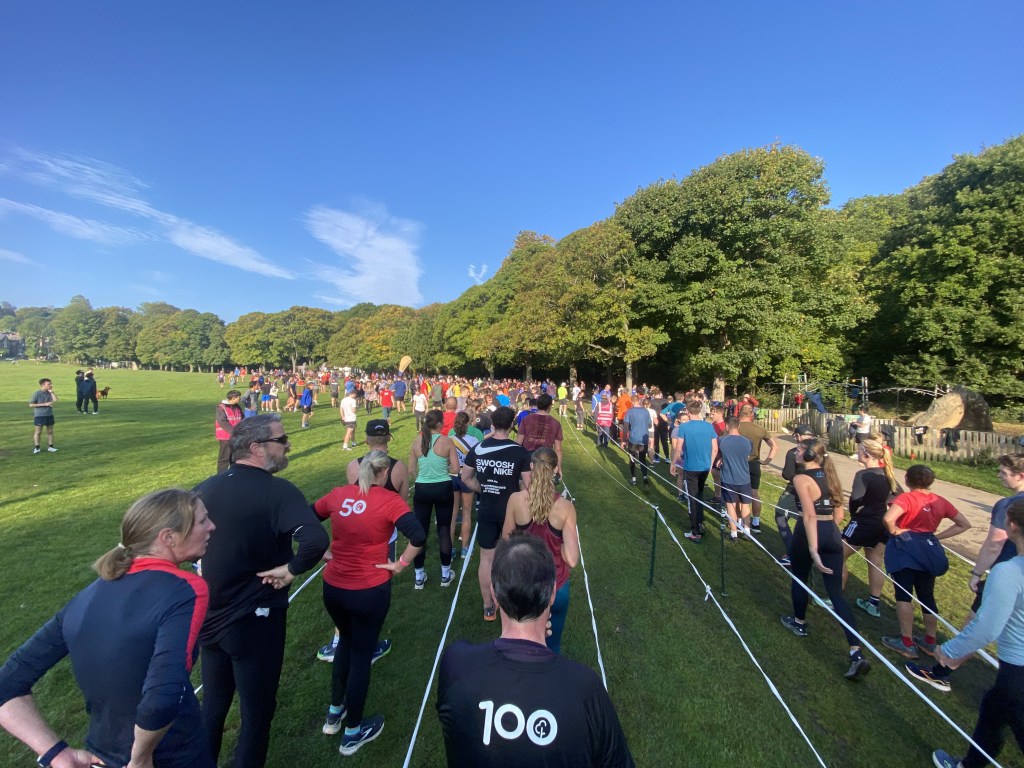
My local parkrun at Sheffield’s Endcliffe Park this last weekend was a biggie. It could’ve been the weather, it could’ve been the fact that that the university students were back, or it could’ve been that people had heard it was parkrun’s 20th birthday. By chance, our latest parkrun research paper was due to come out around now so we’d been able to time it to coincide with the birthday celebrations. It had taken me around two years to write, because we were trying to do something difficult: work out the value of parkrun.
£667m per year: really?
If want to know the full gory details, it’s here, in Plos Global Public Health. The method once you know how to do it is remarkably simple: you ask a government-mandated question about wellbeing, the answer to which economists have worked out the value of. The question is this:
“Overall, how satisfied are you with your life nowadays? where 0 is ‘not at all satisfied’ and 10 is ‘completely satisfied’.”
The trick is that, using this scale, a change of one point for a year (per person) is called a WELLBY (short for wellbeing-year). Economists tell us that this is worth £13,000. We found that after six months of parkrunning in 2019, people’s life satisfaction increased by just over a quarter of a point, valuing the change at £3,341 for a full year or £1,670 per person for the half year. There were four hundred thousand unique parkrunners that year making the total £667m.
Is all this due to parkrun?
The big question is, how much of any life satisfaction change is due to parkrun? Was it simply the number of parkruns they did? If this was the case, then the effect might be pretty small as around 60% only did only one or two parkruns. In this scenario, we estimated that only 6.4% of the £667m was due to the parkruns (or walks) themselves, meaning parkrun was worth only £40m. Even at this lowly level, every £1 invested in parkrun was worth £16.70 to the economy.
What if the life satisfaction was due to the health and social impact of parkrun? Physical health, mental health, the number of new people met and so on. In this scenario, we estimated that 27.1% of the £667m was due to parkrun, or around £226m. Every £1 invested in parkrun would be worth £98.50 to the economy.
How does parkrun work?
Our research shows that as activity increases, both mental health and physical health scores increase and that this leads to better life satisfaction. The key message here is that the £667m is real: if parkrun was to vanish overnight, then the wellbeing of parkrunners would drop a little. Current research tells us that this would have knock on effects for mental health, physical health, confidence and social connections. Illness would probably increase a little too, and performance in the workplace would drop. The government would have to pay at least £667m to get their life satisfaction back to where it was before.
Luckily, parkrun is here to stay.
 Steve Haake